
Second Life is not a game. It never was.
Second Life is an ‘Internet-based virtual world’ (‘Second Life’, 2007), designed, indeed, to let users live their second lives there. Granted, there are several elements as yet unachievable in real life, particularly flying and being able to cross swords and exchange gunfire without getting permanently hurt. But these were user-created functions and activities, much like the same way people set up companies specializing in tactical sports and war games.
With Second Life’s unique customizability, objects of any size from a shoe to a 20-storey building can be created with its user-friendly graphics tools. As such, virtually any place or event in the world can be recreated. Already in other games such as World of Warcraft, there was an instance of guild members holding a funeral or mourning session in-game to mark the real life passing of one of their members (Levy, 2007). If such events can be conducted in a fantasy-themed environment geared towards slaying monsters and warring with other guilds, what more in Second Life, which was designed specifically to simulate real life?
Agendas can also be carried out in Second Life. Just as how Joseph DeLappe ‘has turned “America’s Army” into a war protest and a memorial to dead soldiers’ (Clarren, 2006) by logging into the game and doing nothing but periodically typing in ‘the name of each service person killed in Iraq’ (Clarren, 2006), or how World of Warcraft is famed for its ‘intricately planned raids on dungeons’ (Levy, 2007), Second Life Residents can, with abit of organization, gather at a particular place to protest against or rally for any issue, or in fact, do just about anything as a collective body. A stark example of this was in mid-January of this year, 2007, when a group who called themselves the Second Life Left Unity bought land next to the controversial Front National party’s virtual headquarters and started rallying protests with the aim of eventually driving the Front National out of Second Life (Burkeman, 2007).
Finally, ‘games’ characteristically require some form of suspension of disbelief, of imagination and fantasy. Games provide a form of escape from the dull world we live in, which is why to players, it is fine to kill, steal, and rape in Grand Theft Auto, and it is nothing unusual to launch yourself 30ft in the air by controlling an invisible Force, and throwing lightsabers at surprised opponents. As mentioned earlier, there are a few aspects of Second Life that are fantasy, but a great majority of norms, beliefs, and values are identical to that of the real world. Vandalism, cyber-rape, and harassment are frowned upon. Helping new players find their way around and answering any queries they might have are considered magnanimous and helpful actions. We are reminded of the reality of our physical world while playing in Second Life, something that, I believe, makes the game so popular.
For the most part, after all, Second Life is merely a slightly different parallel universe, modified to allow us a little more freedom that nature denies us here on planet Earth. I wouldn’t just call such liberty ‘a game’.
References
(2007, April 6). ‘Second Life’. Retrieved April 7 from the Wikipedia website at http://en.wikipedia.org/wiki/Second_Life
Levy, S. (2007). World of Warcraft: Is It a Game? Retrieved April 7 from the MSNBC.com website at http://www.msnbc.msn.com/id/14757769/site/newsweek/page/3/print/1/displaymode/1098/
Clarren, R. (2006, September 16). Virtually dead in Iraq. Retrieved April 7 from the salon.com website at http://www.salon.com/ent/feature/2006/09/16/americasarmy/
Burkeman, O. (2007, January 20). Exploding pigs and volleys of gunfire as Le Pen opens HQ in virtual world. Retrieved April 7 from the Guardian Unlimited Network website at http://www.guardian.co.uk/france/story/0,,1994882,00.html
This blog is licensed under a Creative Commons Attribution-Noncommercial-No Derivative Works 3.0 License.
Showing posts with label Assignment. Show all posts
Showing posts with label Assignment. Show all posts
Saturday, April 7, 2007


Friday, April 6, 2007
QotW10: Samurai Estates
So I finally got the heck out of Orientation Island. After visiting Lion City for abit, I headed for the one island that's been on my mind ever since it was mentioned by Kevin.
Samurai Island.

Those who know me well enough probably won't find it much of a surprise, given my fascination (obsession?) with Japanese anime. And if going around slashing people with katanas is forbidden in my first life, I'm quite happy it's perfectly catered to in my second life.

Unfortunately with my superbly advanced computer and flawless Internet connection, half the textures could not load, and this was the best I could get on snapshots. Pretty neat though, having a house built solely for a photo op (as far as I could surmise).

Basically because of the lag and all I didn't really know where I was going. I was basically flying, landing, walk in, walk out, flying, etc. I thought this steaming/smoking thing in the centre was nice though. Cool lotus sculpture. At least it looks like one.

On top of the waterfall, somewhere around the Bait Shop.
It was here that I noticed that being connected in one straight line, I'd unknowingly ventured into Samurai Tokyo.

Splendidly built bridge!
Right. Me.
My first name is my standard alias, Farinelli. For my last name I decided to find an Italian name starting with R... for Renhao. And so I ended up with Robbiani.
Ciao, signore e signora. Io son Farinelli. Farinelli Robbiani.
Eh eh... not bad right?

Even though I took an Italian name, I went for a Chinese look. That's me in Lion City by the way. You can obviously see that I didn't do the eyes too well. I look so stereotypical. As for likeness to self, it's totally like me - my ideal self. I hope to look like that someday. I also hope to get cracking soon. The hair, by the way, is abit out of my reach... I have naturally curly and rather thin hair, so rebonding will make me look more gay than... I dunno, Sanjaya or Paul Twohill. Other than that, the rest of my avatar's look is... achievable. Clothing included.

That's me at Lion City's Centopath (hope I got that right). It was done very well. When you fly close to it you can see that the texture is amazing.
A little more about Samurai Regional Estates. Samurai Regional Estates consists of three vertically interlinked islands, comprising, from top to bottom, Samurai Tokyo, Samurai Island and Samurai Edo. Samurai Island allows users to either rent shops to sell katanas or to buy katanas from these sellers. Samurai Edo is the actual fighting grounds.
Samurai Island's House of Blade Mall rules are rather strict, disallowing particles, listeners, timers, spinning/rotating objects, autoplay/running sounds, lights, 3D vendor machines, etc. etc. etc. This is probably to ensure that the overseer, going by the name KatanaBlade Anubis, can handle daily operations easily, and also to maximize shopping pleasure for users. As it is written on the site, 'it is a fact people do not like to shop in laggy malls'.
As for Samurai Edo, I could not access it because it was members-only, but there were people outside sparring, and one member was so kind as to show me a few moves with her spear.

Practicing

Nice avatar, praticing too

Jane Kit showing her moves for me

Standing around looking cool
I should make Samurai Island my home. Heh.
References
"KatanaBlade Anubis" (2006, July). Samurai Regional Estates - Mall Rules. Retrieved April 6, 2007, from http://samurai.katanablade.net/index.php?option=com_content&task=view&id=14&Itemid=54
Samurai Island.

Those who know me well enough probably won't find it much of a surprise, given my fascination (obsession?) with Japanese anime. And if going around slashing people with katanas is forbidden in my first life, I'm quite happy it's perfectly catered to in my second life.

Unfortunately with my superbly advanced computer and flawless Internet connection, half the textures could not load, and this was the best I could get on snapshots. Pretty neat though, having a house built solely for a photo op (as far as I could surmise).

Basically because of the lag and all I didn't really know where I was going. I was basically flying, landing, walk in, walk out, flying, etc. I thought this steaming/smoking thing in the centre was nice though. Cool lotus sculpture. At least it looks like one.

On top of the waterfall, somewhere around the Bait Shop.
It was here that I noticed that being connected in one straight line, I'd unknowingly ventured into Samurai Tokyo.

Splendidly built bridge!
Right. Me.
My first name is my standard alias, Farinelli. For my last name I decided to find an Italian name starting with R... for Renhao. And so I ended up with Robbiani.
Ciao, signore e signora. Io son Farinelli. Farinelli Robbiani.
Eh eh... not bad right?

Even though I took an Italian name, I went for a Chinese look. That's me in Lion City by the way. You can obviously see that I didn't do the eyes too well. I look so stereotypical. As for likeness to self, it's totally like me - my ideal self. I hope to look like that someday. I also hope to get cracking soon. The hair, by the way, is abit out of my reach... I have naturally curly and rather thin hair, so rebonding will make me look more gay than... I dunno, Sanjaya or Paul Twohill. Other than that, the rest of my avatar's look is... achievable. Clothing included.

That's me at Lion City's Centopath (hope I got that right). It was done very well. When you fly close to it you can see that the texture is amazing.
A little more about Samurai Regional Estates. Samurai Regional Estates consists of three vertically interlinked islands, comprising, from top to bottom, Samurai Tokyo, Samurai Island and Samurai Edo. Samurai Island allows users to either rent shops to sell katanas or to buy katanas from these sellers. Samurai Edo is the actual fighting grounds.
Samurai Island's House of Blade Mall rules are rather strict, disallowing particles, listeners, timers, spinning/rotating objects, autoplay/running sounds, lights, 3D vendor machines, etc. etc. etc. This is probably to ensure that the overseer, going by the name KatanaBlade Anubis, can handle daily operations easily, and also to maximize shopping pleasure for users. As it is written on the site, 'it is a fact people do not like to shop in laggy malls'.
As for Samurai Edo, I could not access it because it was members-only, but there were people outside sparring, and one member was so kind as to show me a few moves with her spear.

Practicing

Nice avatar, praticing too

Jane Kit showing her moves for me

Standing around looking cool
I should make Samurai Island my home. Heh.
References
"KatanaBlade Anubis" (2006, July). Samurai Regional Estates - Mall Rules. Retrieved April 6, 2007, from http://samurai.katanablade.net/index.php?option=com_content&task=view&id=14&Itemid=54
Friday, March 16, 2007
QotW7: Birds of a Feather Flock to Twitter
The thing about Twitter is that it has come to serve an unintended  purpose. Originally it was just meant to tell your community what you activities you were engaging in – boring stuff at first glance. There are plenty of other ways to do that without having to sign up to a website, then log in and enter your activity information. And there’s that hassle of digging up your whole community from the whole pool of the Web, or inviting friends if you are all that serious about it.
As communities grew, people must have seen an interesting activity on someone else’s profile, or more accurately an activity of interest to them, and used their text box to enter a comment about their friend’s activity. One can imagine how fast that trend caught on – probably faster than you can say tweet. :)

It was the same with the COM125 class community. And by now, you might have deduced that I agree that Twitter is an online community, albeit an unintentional one. We all signed up for it as instructed, rather skeptical of the uses of such a site. Early birds (hurhur) sent invitations to their closer friends. And in just half a week, as the class community started to build up with more people signing up, it started to look more like a web-based messaging client than a what-I-am-doing-now site. Having discovered the code for replying (@[username]), we were joking and laughing about the most silly things, flooding newcomers with welcome messages, and even communicating discreetly during another class held in the computer lab. We have held discussions on what to do the next day, and input suggestions and instructions on how to complete assignments. We do that all the time on MSN Messenger, or should I say Windows Live Messenger now, but rarely with as many people at once, and such a sense of togetherness as felt on Twitter.

Wellman and Gulia in their paper Net Surfers Don’t Ride Alone identified a few researchers warning about the dangers of making affliations with strangers on the Web in a virtual community (1996). One thing about Twitter is that the virtual communities there are most likely to be communities where members know each other, with the exception of users with a more popular status such as Singaporean blogger mrbrown. The COM125 class community, of course, knows everyone else at the very least by face. So perhaps we get to know each other more, instead of the usual scenario of interacting with total strangers across the world. The activities of a gift community, like giving aid or reciprocation of help, as discussed by Kollock (1999), looks to be enhanced, as compared to a forum or community of strangers.
Fernback and Thompson commented that "communities seem more likely to be formed or reinforced when action is needed" (1995). With the, for lack of a better word, forced formation of our Twitter community, it seems that we have reversed the process and found ourselves a purpose, or indeed purposes, for the existence of our community. With this function that the Twitter users decided for themselves, namely that of using it as an asynchronous messaging service, Twitter has become a prime site for virtual communities. Technically, it could be considered an online community with its original function, but there is only so much fun in seeing what your friends are doing, and I doubt it would have taken off as it has if people had stuck to doing that.
References
Fernback, J. and Thompson, B. (1995, May). Virtual Communities: Abort, Retry, Failure? Retrieved March 15, 2007, from
http://www.rheingold.com/texts/techpolitix/VCcivil.html
Kollock, P. (1999). The Economies of Online Cooperation: Gifts and Public Goods in Cyberspace. Retrieved February 9 from http://www.sscnet.ucla.edu/soc/faculty/kollock/papers/economies.htm
Wellman, B, and Gulia, M. (1996, April). Net surfers don't ride alone. Retrieved March 15, 2007, from
http://www.acm.org/%7Eccp/references/wellman/wellman.html
purpose. Originally it was just meant to tell your community what you activities you were engaging in – boring stuff at first glance. There are plenty of other ways to do that without having to sign up to a website, then log in and enter your activity information. And there’s that hassle of digging up your whole community from the whole pool of the Web, or inviting friends if you are all that serious about it.As communities grew, people must have seen an interesting activity on someone else’s profile, or more accurately an activity of interest to them, and used their text box to enter a comment about their friend’s activity. One can imagine how fast that trend caught on – probably faster than you can say tweet. :)

It was the same with the COM125 class community. And by now, you might have deduced that I agree that Twitter is an online community, albeit an unintentional one. We all signed up for it as instructed, rather skeptical of the uses of such a site. Early birds (hurhur) sent invitations to their closer friends. And in just half a week, as the class community started to build up with more people signing up, it started to look more like a web-based messaging client than a what-I-am-doing-now site. Having discovered the code for replying (@[username]), we were joking and laughing about the most silly things, flooding newcomers with welcome messages, and even communicating discreetly during another class held in the computer lab. We have held discussions on what to do the next day, and input suggestions and instructions on how to complete assignments. We do that all the time on MSN Messenger, or should I say Windows Live Messenger now, but rarely with as many people at once, and such a sense of togetherness as felt on Twitter.

Wellman and Gulia in their paper Net Surfers Don’t Ride Alone identified a few researchers warning about the dangers of making affliations with strangers on the Web in a virtual community (1996). One thing about Twitter is that the virtual communities there are most likely to be communities where members know each other, with the exception of users with a more popular status such as Singaporean blogger mrbrown. The COM125 class community, of course, knows everyone else at the very least by face. So perhaps we get to know each other more, instead of the usual scenario of interacting with total strangers across the world. The activities of a gift community, like giving aid or reciprocation of help, as discussed by Kollock (1999), looks to be enhanced, as compared to a forum or community of strangers.
Fernback and Thompson commented that "communities seem more likely to be formed or reinforced when action is needed" (1995). With the, for lack of a better word, forced formation of our Twitter community, it seems that we have reversed the process and found ourselves a purpose, or indeed purposes, for the existence of our community. With this function that the Twitter users decided for themselves, namely that of using it as an asynchronous messaging service, Twitter has become a prime site for virtual communities. Technically, it could be considered an online community with its original function, but there is only so much fun in seeing what your friends are doing, and I doubt it would have taken off as it has if people had stuck to doing that.
References
Fernback, J. and Thompson, B. (1995, May). Virtual Communities: Abort, Retry, Failure? Retrieved March 15, 2007, from
http://www.rheingold.com/texts/techpolitix/VCcivil.html
Kollock, P. (1999). The Economies of Online Cooperation: Gifts and Public Goods in Cyberspace. Retrieved February 9 from http://www.sscnet.ucla.edu/soc/faculty/kollock/papers/economies.htm
Wellman, B, and Gulia, M. (1996, April). Net surfers don't ride alone. Retrieved March 15, 2007, from
http://www.acm.org/%7Eccp/references/wellman/wellman.html
Saturday, March 10, 2007
QotW6: Watching Each Other
Although my frequent use of the Internet started at a late age compared to my friends and peers, I nevertheless started at the age of 15 or 16. I was 7 years too young for a credit card, not to mention that working was just about the furthest thing from my mind then. Consequently, I’ve never been all that cautious about revealing my personal information on the Net, since there was no financially-related information to be stolen. The boundaries between personal information that can be revealed and personal information that must remain private fleshed itself out as I felt my way around the Net and gradually got used to the culture and environment.
I actually started my blog as a fad. I saw the success that my friend’s blog enjoyed from my class and his circle of friends, and since I prided myself on being able to write well (enough), I figured I’d just start one as well.
Blogger, like any decent interactive site, has a profile page for users to fill up, should they choose to, so that visitors can read more about the author, or more importantly, find a way to contact him, email address or otherwise. Anywhere I go, and anywhere I reveal personal information, I am not worried about physical privacy. I know I haven’t been hacking into CIA, so I cannot imagine anyone out of Singapore trying to find me. And interaction on my blog has led me to believe that hardly anyone outside of my circle of friends reads my blog anyway, more so because I know my content is specific to my current life. In 2004, I blogged about what went on in Victoria School, and in my class 4H. Since last year, most of my posts have something to do with UB-SIM. As such, I feel comfortable revealing more than my usual amount of personal information, since anyone who reads it are likely to already know those details anyway. For example in my Blogger profile page I reveal myself to be staying in Tampines, Singapore. Most of my friends know that, if not all. Anyone new to my blog who even bothers to read the profile page can contact me if they are interested to find out where I live, and I can then assess their intent in finding out my exact address.
Jeffrey Rosen, author of The Naked Crowd, writes that we are in an age where many are watching many, “even though no one knows precisely who is watching or being watched at any given time” (2004). As I begin to blog about a wider scope of subjects, I am gradually increasing my caution on revealing personal information, in anticipation of (hopefully) higher traffic to my blog and an increased range of audiences. Bob Sullivan’s comment that “a simple Google search can reveal what you think” (2006) rings a painful bell as I recall the flame war I recently engaged in as part of my flamers study. I carelessly neglected to create a pseudonym for myself and risked my own privacy. This was revealed to me when the flamer tried to one-up me by posting 10 links to my identity on the Net. It was true that half of those links were dead, remnants of my presence on Web 1.0, and that none were sensitive information that I particularly cared for, but still, I was severely reminded of the possible danger I had put myself in.
As I commented in my Bonus Mission post, we the users of the Web cannot afford to be careless about what we say, or in this case, reveal anymore. Everyone is watching everyone else’s move, and as Professor Alex Halavais commented in the article elaborating on the word he coined, panveillance, “there is the assumption that some form of the video is likely to find its way out onto the web” (2007). We should adopt that assumption with anything we put up on the Net in any medium, and think twice before we reveal anything on the, let’s face it, vicious Internet.
References
Rosen, J. (2004, July 19). The Naked Crowd. Retrieved March 10, 2007 from http://www.spiked-online.com/Printable/0000000CA5FF.htm
Sullivan, B. (2006, October 17). Privacy Lost: Does anybody care?. Retrieved March 10, 2007 from http://www.msnbc.msn.com/id/15221095/print/1/displaymode/1098/
Halavais, A. (2007, March 1). Panveillance. Retrieved March 10, 2007 from http://alex.halavais.net/panveillance/
I actually started my blog as a fad. I saw the success that my friend’s blog enjoyed from my class and his circle of friends, and since I prided myself on being able to write well (enough), I figured I’d just start one as well.
Blogger, like any decent interactive site, has a profile page for users to fill up, should they choose to, so that visitors can read more about the author, or more importantly, find a way to contact him, email address or otherwise. Anywhere I go, and anywhere I reveal personal information, I am not worried about physical privacy. I know I haven’t been hacking into CIA, so I cannot imagine anyone out of Singapore trying to find me. And interaction on my blog has led me to believe that hardly anyone outside of my circle of friends reads my blog anyway, more so because I know my content is specific to my current life. In 2004, I blogged about what went on in Victoria School, and in my class 4H. Since last year, most of my posts have something to do with UB-SIM. As such, I feel comfortable revealing more than my usual amount of personal information, since anyone who reads it are likely to already know those details anyway. For example in my Blogger profile page I reveal myself to be staying in Tampines, Singapore. Most of my friends know that, if not all. Anyone new to my blog who even bothers to read the profile page can contact me if they are interested to find out where I live, and I can then assess their intent in finding out my exact address.
Jeffrey Rosen, author of The Naked Crowd, writes that we are in an age where many are watching many, “even though no one knows precisely who is watching or being watched at any given time” (2004). As I begin to blog about a wider scope of subjects, I am gradually increasing my caution on revealing personal information, in anticipation of (hopefully) higher traffic to my blog and an increased range of audiences. Bob Sullivan’s comment that “a simple Google search can reveal what you think” (2006) rings a painful bell as I recall the flame war I recently engaged in as part of my flamers study. I carelessly neglected to create a pseudonym for myself and risked my own privacy. This was revealed to me when the flamer tried to one-up me by posting 10 links to my identity on the Net. It was true that half of those links were dead, remnants of my presence on Web 1.0, and that none were sensitive information that I particularly cared for, but still, I was severely reminded of the possible danger I had put myself in.
As I commented in my Bonus Mission post, we the users of the Web cannot afford to be careless about what we say, or in this case, reveal anymore. Everyone is watching everyone else’s move, and as Professor Alex Halavais commented in the article elaborating on the word he coined, panveillance, “there is the assumption that some form of the video is likely to find its way out onto the web” (2007). We should adopt that assumption with anything we put up on the Net in any medium, and think twice before we reveal anything on the, let’s face it, vicious Internet.
References
Rosen, J. (2004, July 19). The Naked Crowd. Retrieved March 10, 2007 from http://www.spiked-online.com/Printable/0000000CA5FF.htm
Sullivan, B. (2006, October 17). Privacy Lost: Does anybody care?. Retrieved March 10, 2007 from http://www.msnbc.msn.com/id/15221095/print/1/displaymode/1098/
Halavais, A. (2007, March 1). Panveillance. Retrieved March 10, 2007 from http://alex.halavais.net/panveillance/
Bonus Mission #1: Omnipticon
Quite frankly, I've been on a desperate lookout for unfortunate people whose actions would be immortalized through the eye of my camera phone. The award goes to this uncle on the 151 bus I was taking with Graham.


Thinking about it, I have no problem with people who clip their nails discreetly. Because to be brutally honest, I don't care that the nails fall onto the bus floor. It's a public bus. We don't lick the floors of private buses, let alone public buses. And the driver does a sweep at the end of each round anyway.
I know I'm bad.
More importantly, he was doing it blatantly, and... 'enthusiastically'. It was a 3-in-1 clipper, so our friend dug dirt from under his cuticles with all his might, clipped his nails with all his might, filed with all his might, and blew at his nails with all his might. Moreover, his nails are thick, and dirty (smoker, I think). The problem I have with this strange factor relates to a personal experience.
Once, I was clipping my toenails outside my house, sitting on the staircase landing. I was waging a world war with my big toe nail because it refused to be clipped, stopping the almighty power of the nail clipper halfway through. I twisted and rattled the nail clipper, and that stupid big toenail taught me a big lesson by sacrificing itself.
Before I could react, half the nail snapped off, and boomeranged towards my face. It missed me in the end, but I froze in icy fear as it passed by my ear, or more accurately BUZZED past my ear. That's right. It was spinning so fast from flying off that it went vvmmm as it shot past me. I knew then how it felt to have bullets missing you by an inch - how it felt and how it sounded. That thing could have sliced my eyebrow off!
Now. Return to the uncle in the bus. The bus was relatively empty, but what if there had been people behind him?! Or in fact, as you can see I was to the slight bottom right of him. The clipped nail could have flown up down left right, and hit someone. If it doesn't cause physical damage, at least stop to think of the psychological damage caused by pulling a cut nail from your hair.
Rosen very aptly coined a new word in his article The Naked Crowd. 'Omnipticon', 'in which the many watch the many, though no one knows precisely who is watching or being watched at any given time' (Rosen, 2004). This uncle has the luxury of not worrying about this, unless he has an affair with...... which looks unlikely, in any event. But we, the users and wielders of the Internet, of Web 2.0, have to consider and consider again our every move and action. A racially biased joke meant to be kept within a small community of friends has a million ways of being leaked to the wrath of the whole world, we've seen instances of that happening so many times. In these times, we cannot afford anymore to be careless or frivolous about what we say or do, online, or offline.
References
Rosen, J. (2004, July 19). The Naked Crowd. Retrieved March 10, 2007 from http://www.spiked-online.com/Printable/0000000CA5FF.htm


Thinking about it, I have no problem with people who clip their nails discreetly. Because to be brutally honest, I don't care that the nails fall onto the bus floor. It's a public bus. We don't lick the floors of private buses, let alone public buses. And the driver does a sweep at the end of each round anyway.
I know I'm bad.
More importantly, he was doing it blatantly, and... 'enthusiastically'. It was a 3-in-1 clipper, so our friend dug dirt from under his cuticles with all his might, clipped his nails with all his might, filed with all his might, and blew at his nails with all his might. Moreover, his nails are thick, and dirty (smoker, I think). The problem I have with this strange factor relates to a personal experience.
Once, I was clipping my toenails outside my house, sitting on the staircase landing. I was waging a world war with my big toe nail because it refused to be clipped, stopping the almighty power of the nail clipper halfway through. I twisted and rattled the nail clipper, and that stupid big toenail taught me a big lesson by sacrificing itself.
Before I could react, half the nail snapped off, and boomeranged towards my face. It missed me in the end, but I froze in icy fear as it passed by my ear, or more accurately BUZZED past my ear. That's right. It was spinning so fast from flying off that it went vvmmm as it shot past me. I knew then how it felt to have bullets missing you by an inch - how it felt and how it sounded. That thing could have sliced my eyebrow off!
Now. Return to the uncle in the bus. The bus was relatively empty, but what if there had been people behind him?! Or in fact, as you can see I was to the slight bottom right of him. The clipped nail could have flown up down left right, and hit someone. If it doesn't cause physical damage, at least stop to think of the psychological damage caused by pulling a cut nail from your hair.
Rosen very aptly coined a new word in his article The Naked Crowd. 'Omnipticon', 'in which the many watch the many, though no one knows precisely who is watching or being watched at any given time' (Rosen, 2004). This uncle has the luxury of not worrying about this, unless he has an affair with...... which looks unlikely, in any event. But we, the users and wielders of the Internet, of Web 2.0, have to consider and consider again our every move and action. A racially biased joke meant to be kept within a small community of friends has a million ways of being leaked to the wrath of the whole world, we've seen instances of that happening so many times. In these times, we cannot afford anymore to be careless or frivolous about what we say or do, online, or offline.
References
Rosen, J. (2004, July 19). The Naked Crowd. Retrieved March 10, 2007 from http://www.spiked-online.com/Printable/0000000CA5FF.htm
Thursday, February 22, 2007
QotW5: Identity Theft
My personal policy is that my IM account should be reserved for my friends or people I’m otherwise acquainted with. Ditto with my Friendster or Facebook account. I have three email accounts with Gmail, Hotmail, and Yahoo, and depending on my level of trust, I would decide which to use – Gmail for personal and professional communication, Hotmail for sign-ups requiring email verification and the like, Yahoo for the shady stuff. ;D
According to the Online Identity article on Wikipedia, "an online identity is a social identity that network users establish in online communities" (“Online Identity”, 2007). It is a mark of how important online identities have become today that there are numerous services purportedly dedicated to managing and even protecting your online identity, or identities (ClaimID, 2007; OnXiam, n.d.; ReputationDefender, 2007; Naymz, 2006) . Of late, in forums, and more recently IRC, I have taken to using the pseudonym Farinelli, as a tribute to the legendary castrato singer. It’s quite effective; I’ve yet to see anyone else use it. If someone else does, I’m pretty sure our paths don’t clash.
When I post on forums or reply to questions in IRC, I do so because, as mentioned by Judith Donath, I want to help (Donath, 1996) and feel that I have the adequate knowledge and relevant expertise to do so. I am in this way able to build a reputation for myself, if not for being an expert in a particular field, then at least for being a decent poster instead of a troll or flamer. In this age of highly increased interactivity on the Web, there seems to exist an underlying current of wariness towards newcomers until they prove themselves worthy of the forum’s trust.
In forums where media is exchanged, such as PDF form books or musical scores, video files of anime episodes, or image files of scanlated manga, being able to provide the material in question commands a certain amount of respect, and consequently reputation. In IRC or some forums, having the capability to act as a file distribution server also earns you reputation, and privileges as well, notably prioritized access to long-queuing files or a higher share of bandwidth. Long story short, the only alternative method to slowly building authority on a forum through exhibiting your knowledge is to have material possessions.
If one even has to choose a nickname, chances are that forum requires registration to utilize. Once I secure Farinelli, a newcomer probably has to be the moderator’s best friend to snatch that pseudonym from me. In some forums however, the login name is not necessarily the same as the displayed name, and malicious posters can simply change their nickname to Farinelli, post a whole load of incendiary trash, and change his nickname back to the original one. It is far from infallible, but it still takes a whole lot of time to track down, assuming the virtual community even thinks it might be someone faking my name. It is possible that for fear of losing track of the main purpose of the forum, they would just shun me aside in order to get back on track ASAP. Such is the level of damage I feel can be caused to the online reputation which I have taken time and effort to build.
References
“Amilgate” (2007, Jan 15). Online Identity. Retrieved February 21, 2007, from Identity and Deception in the Wikipedia Web site: http://en.wikipedia.org/w/index.php?title=Online_identity&diff=108207999&oldid=106705378
ClaimID (2007). About ClaimID. Retrieved February 22, 2007, from ClaimID Web site:
http://claimid.com/about
Donath, J. M. (1996, Nov 12). Identity and deception in the virtual community. Retrieved February 21, 2007, from Identity and Deception in the Virtual Community Web site: http://smg.media.mit.edu/people/Judith/Identity/IdentityDeception.html
Naymz (2007). What is Naymz? Retrieved February 22, 2007, from Naymz Web site:
http://www.naymz.com/about.action
Poulsen, K. (2007). About OnXiam. Retrieved February 22, 2007, from OnXiam Web site:
http://www.onxiam.com/about/
ReputationDefender (2007). ReputationDefender > About Us. Retrieved February 22, 2007, from ReputationDefender Web site:
http://www.reputationdefender.com/about.php
According to the Online Identity article on Wikipedia, "an online identity is a social identity that network users establish in online communities" (“Online Identity”, 2007). It is a mark of how important online identities have become today that there are numerous services purportedly dedicated to managing and even protecting your online identity, or identities (ClaimID, 2007; OnXiam, n.d.; ReputationDefender, 2007; Naymz, 2006) . Of late, in forums, and more recently IRC, I have taken to using the pseudonym Farinelli, as a tribute to the legendary castrato singer. It’s quite effective; I’ve yet to see anyone else use it. If someone else does, I’m pretty sure our paths don’t clash.
When I post on forums or reply to questions in IRC, I do so because, as mentioned by Judith Donath, I want to help (Donath, 1996) and feel that I have the adequate knowledge and relevant expertise to do so. I am in this way able to build a reputation for myself, if not for being an expert in a particular field, then at least for being a decent poster instead of a troll or flamer. In this age of highly increased interactivity on the Web, there seems to exist an underlying current of wariness towards newcomers until they prove themselves worthy of the forum’s trust.
In forums where media is exchanged, such as PDF form books or musical scores, video files of anime episodes, or image files of scanlated manga, being able to provide the material in question commands a certain amount of respect, and consequently reputation. In IRC or some forums, having the capability to act as a file distribution server also earns you reputation, and privileges as well, notably prioritized access to long-queuing files or a higher share of bandwidth. Long story short, the only alternative method to slowly building authority on a forum through exhibiting your knowledge is to have material possessions.
If one even has to choose a nickname, chances are that forum requires registration to utilize. Once I secure Farinelli, a newcomer probably has to be the moderator’s best friend to snatch that pseudonym from me. In some forums however, the login name is not necessarily the same as the displayed name, and malicious posters can simply change their nickname to Farinelli, post a whole load of incendiary trash, and change his nickname back to the original one. It is far from infallible, but it still takes a whole lot of time to track down, assuming the virtual community even thinks it might be someone faking my name. It is possible that for fear of losing track of the main purpose of the forum, they would just shun me aside in order to get back on track ASAP. Such is the level of damage I feel can be caused to the online reputation which I have taken time and effort to build.
References
“Amilgate” (2007, Jan 15). Online Identity. Retrieved February 21, 2007, from Identity and Deception in the Wikipedia Web site: http://en.wikipedia.org/w/index.php?title=Online_identity&diff=108207999&oldid=106705378
ClaimID (2007). About ClaimID. Retrieved February 22, 2007, from ClaimID Web site:
http://claimid.com/about
Donath, J. M. (1996, Nov 12). Identity and deception in the virtual community. Retrieved February 21, 2007, from Identity and Deception in the Virtual Community Web site: http://smg.media.mit.edu/people/Judith/Identity/IdentityDeception.html
Naymz (2007). What is Naymz? Retrieved February 22, 2007, from Naymz Web site:
http://www.naymz.com/about.action
Poulsen, K. (2007). About OnXiam. Retrieved February 22, 2007, from OnXiam Web site:
http://www.onxiam.com/about/
ReputationDefender (2007). ReputationDefender > About Us. Retrieved February 22, 2007, from ReputationDefender Web site:
http://www.reputationdefender.com/about.php
Friday, February 9, 2007
QotW4: The Listserv as Gift Economy
Towards the end of 2003, I was introduced to a new genre of music. I was listening to Russell Watson and looking through the liner notes, decided to look for Puccini’s Turandot, where one of his most impressive songs, Nessun Dorma, was taken from. I went to the library@esplanade and found Maria Callas’s recording. And it was thus that my love for opera was born.
My journey into the depths of opera was complimented by my gradually increasing use of the computer, and the Internet. In 2004, while I was surfing around for anything opera, I chanced upon the Opera-L Listserv. What I saw as I explored the site and the message archives greatly excited me. An online community talking about nothing but opera, with messages delivered right to my inbox?! It did not take long for me to sign up. And there I would stay for almost two years.
Opera-L has the distinct characteristics of a gift economy, explored in the following paragraphs.
Information that would otherwise be exclusive is shared. Recently a trend in Opera-L has been uploading videos to Youtube. A good majority of the community is middle-aged or elderly, and are not that tech-savvy as they would like to be. A poster who did not get any response when she asked for a solution to rip DVD clips out fit for uploading earlier posted and thus shared a solution which she stumbled upon (Curtis, 2006). For the younger folks such as I, we often dispense technical advice on uploading videos to Youtube, ripping songs into MP3 format, transferring those MP3s into the iPod and so on. We also do not hesitate to post queries about stuff like the significance of the use of a particular instrument in a particular passage of music, or the changes in musical dynamics that seems rather strange, or about the roles a particular singer was famous for. This reflects the give-and-take mentality, contributing to solving issues raised in the community you are in with an implicit expectation of reciprocated help when you need it (Kollock, 1999).
Kollock also mentioned that a characteristic of public goods, which the information and media in gift economies typically are, is that 'the size of the group necessary to produce many public goods is often reduced to one' (Kollock 1999). Take this example of a lister who posted the following message:
Date: Fri, 6 Jan 2006 15:29:58 -0500
Reply-To: glhoffman@COX.NET
Sender: Discussion of opera and related issues
From: Gary Hoffman
Subject: Mozart's Requiem Uploaded for Streaming
Content-Type: text/plain; charset=ISO-8859-1
I have uploaded Mozart's Requiem to my web site. It is available for streaming. The performers are Irmgard Seefried, Hildegard Rössel-Majdan, Anton Dermota, Gottlob Frick, Wiener Staatsopernchor, Wiener Philharmoniker, Karl Böhm (cond.). It is a live recording from Vienna, 20 November 1955. Windows Media Player and Winamp are recommended.
Saluti,
Gary Hoffman
Opera Today [http://www.operatoday.com/]
This is another example of sharing. It is not uncommon on Opera-L to upload recordings to your personal website and then notify the list, so contributors can have a confident expectation of accessibility to other recordings in return. But notice that this lister obtained the CD or audio record, ripped it out, and put it on his website for streaming – all by himself. Not every gift economy has to be Linux-like – hundreds of thousands of people somehow coming together to achieve an ambitious goal. Little bits of information that are being posted and exchanged with each other daily can also turn a community into a valuable source of information.
Finally, Kollack comments that the Net ‘works a bit like a committee: you'll need a few dedicated persons who do most of the stuff or nothing will get done.’ (Kollack, 1999). Strictly speaking, there is only one person overseeing and moderating posts where necessary. But over the decade or so that this listserv has been around, several regulars have taken on an informal role of what I call sub-moderators. They enjoy no special privileges, except perhaps a certain amount of respect from the group, but are very knowledgeable and often correct wrong perceptions, or step into arguments to clarify the facts. These members of the group may simply be veterans, but without them, it is clear that the moderator will have much much more to cope with than he already has now.
Opera-L has proven itself invaluable in keeping me up-to-date with knowledge of the opera scene around the world. Listers, no matter how few, never fail to somehow respond to a query or request, and it also pleases me greatly when I give back to this wonderful listserv in the form of IT or electronics advice. I slowly realized, however, that I was gaining less and less from the list, that clearing the digest emails were getting to be a chore. A few months back I made the decision to turn off the emailing function, ceasing the daily updates. My experience with the list, however, has equipped me with the firm knowledge that if ever I need or want to look up opera-related news, there is somewhere, someplace, on the almost infinite Web, that I can trust for that information.
REFERENCES
Kollock, P. (1999). The Economies of Online Cooperation: Gifts and Public Goods in Cyberspace. Retrieved February 9 from http://www.sscnet.ucla.edu/soc/faculty/kollock/papers/economies.htm
Hoffman, G. (2005). Mozart's Requiem Uploaded for Streaming. Opera-L archives -- January 2006, week 1 (#327). Retrieved February 9 2007 from http://listserv.cuny.edu/Scripts/wa.exe?A2=ind0601A&L=OPERA-L&P=R13206&1=OPERA-L&9=A&I=-3&K=1&X=411ED672EBB81EFFA4&Y=wongrenhao%40gmail.com&d=no+match%3Bmatch%3Bmatches&z=4
Curtis, G. (2006). Uploading to YouTube. Opera-L archives -- September 2006, week 4 (#76). Retrieved February 9 2007 from http://listserv.cuny.edu/Scripts/wa.exe?A2=ind0609D&L=OPERA-L&P=R3879&1=OPERA-L&9=A&I=-3&K=1&X=6A3B2C4A40706CD2F7&Y=wongrenhao%40gmail.com&d=no+match%3Bmatch%3Bmatches&z=4
Saturday, February 3, 2007
QotW3: Pleasing Both Sides...?
Record labels are tyrants whose sole aim is to suck money from music fans. Pirates are simply rebels risking their lives and sacrificing their time to make the people's lives better by sneaking rice and meat, expensive commodities, to them for free. Unable to have any precise method of pinpointing the culprits, the tyrants close their eyes and fling their axes out – whoever happens to be standing where it lands get it hard. Life sucks, but the peasants are getting smarter, and a rebellion seems to be brewing hot and fast...
Whether the above analogy provides a biased or unbiased view of the situation between the major record labels and the common folk today is debatable. That, however, was the point of view I got from reading the articles related to this tricky little issue of copyright and piracy. Equally tricky though is the question of finding a solution that would please both sides – a win-win situation. But when the primary objective of this game is profit, can both parties really gain, or must one lose?
Music fans want easy and cheap access to their favorite bands’ songs. The advent, though, of P2P and file sharing technologies where the only major investment is time (even then multi-tasking allows one to do five different things while the P2P program searches in the background, and ten more while it downloads), may make it a little hard to lure the fans back to paying for their music, however nominal or arguably reasonable the fee. Record labels on the other hand, want to maximize their profits, not reward their artists. They have tried working with companies to introduce MP3 download sites like the iTunes Music Store, offering cheap MP3 files without the usual frills of covers and liner notes, but compared to the 5 billion files shared over Kazaa every month, the 100 million downloads iTunes managed to score in its first 15 months of operation (von Lohmann, 2004) is dishearteningly measly, and confirms the hypothesis at the beginning of this paragraph that given the candy of free music, fans would rather stick to that over the iced water that are cheap MP3s.
Some bloggers, in discussing this issue, have suggested purposely setting up a record company which offer artists a better portion of profits and steal all the big names over (Baude, 2003). That would require a lot of goodwill and money from a few people, but it would certainly help artists should they choose to boycott big name labels for exploiting them and the music industry. We know that a lot of bands who have not been totally blinded by the money retain their musicianship’s integrity that the fans, especially in the heavier side of the rock/metal scene, so respect. When two DJs came under fire from the record companies for remixing Green Day’s American Idiot album ‘with music from a variety of other artists including Aerosmith and Eminem’, ‘Green Day came out publicly to say they were flattered by the album, and liked it’ (Catapult, 2005). This is a stark example of artists’ current dissatisfaction with record companies. Thus by choosing labels whose primary focus is to fulfill the wants of music fans, artists can have their fair share of profits for their hard work and dedication, the label will earn either because of the number of bands defecting to their side, or from the exponential leap in album sales, and fans of course can get their music at a cheaper, more affordable and reasonable price. This is quite a one-sided solution in favour of the music fans, but the underhand tactics with which the record companies try to make profits and more profits frankly does not leave the desire for much negotiation.
Another solution which would be fairer to the record companies would involve them slashing the prices of online MP3 files by 1) doing away with CD production (or producing limited copies) and 2) selling the files directly from their websites, without a middleman such as Apple, Creative and Soundbuzz. Doing away with CD production and eliminating the middlemen will greatly reduce unnecessary costs that the record labels would eventually push to the consumers as part of product costs anyway. With these two measures I predict a possible cut in prices of 50%, if not more, effectively creating a significant gap between CD prices and MP3 files online. This would make music fans feel more like they are paying to support their artists’ work, instead of feeding the record companies.
I must admit that as a consumer myself, I suspect I am quite strongly biased whether I like it or not towards the consumer point of view. All I can say to the record companies, as objectively as I can be, is that if in their quest for profits they are not willing to let off on the exorbitant prices, there is a new generation of indignant music fans waiting to take over the music scene. You guys should do some re-thinking before you go out of business.
References
(2005, May 23). Remix culture: a rights nightmare. Retrieved February 2, 2007, from Catapult (ABC Online) Web site: http://www.abc.net.au/catapult/indepth/s1645533.htm
von Lohmann, F. (2004, Sept 9). Is Suing Your Customers a Good Idea?. Retrieved February 2, 2007, from Law.com Web site: http://www.law.com/jsp/article.jsp?id=1095434496352
Baude, W. (2003, Sept 13). Are Music Companies Evil? or The Founding of Baude Records. Retrieved February 2, 2007, from Crescat Sententia Web site: http://www.crescatsententia.net/archives/2003/09/13/
Saturday, January 27, 2007
COM125 Week 2: The Rise of Political Blogging
The blogging concept has taken the world, or at least the cyberworld, by storm. For no charges at all, you are offered a flexibly customizable site of your own to display your thoughts to the world, with an online software to make inputting those thoughts child’s play. If you enjoy writing, or entertaining people, there really are not many reasons to refuse such an offer. And so it was that having your own blog became hip in 2002, according Hobbes’ Internet Timeline (Zakon, 2006). This boom set new heights on many different levels – a new way of socialization, a new form of entertainment, and a great source of income for some. But what I feel is the greatest, and possibly most unexpected result of the blogging boom, is its effects on politics.
As with the original concept of blogging, political blogging started out small, with few big names before 2001. 2001 was when ‘several broadly popular American blogs emerged’ (ed. Mmmovie, 2007), like AndrewSullivan.com, Politics1.com, Political Wire, and MyDD, all focusing primarily on politics. By 2002, the pervasiveness of politics in the blogosphere, as well as the influence of the blogosphere, was spectacularly shown when comments by U.S. Senate Majority Leader Trent Lott were interpreted as approval towards racial segregation. Bloggers dug up documents and interviews suggesting that this was indeed true. Even though the media who attended the event did not pick up on the comments initially, the combined impact of the bloggers’ comments and documents turned it into a political crisis, and Lott was forced to step down (ed. Mmmovie, 2007).
Closer to home here in Asia, countries often do not get as much press or political freedom to say what they want. One popular way of sidestepping that is to satirize your comments, as Singaporean blogger Mr. Brown often does. Through podcasts, he often exaggerates political concerns into comic situations. Apart from avoiding trouble with the authorities, this method has, wittingly or unwittingly, gained Mr. Brown a huge readership.
The sudden suspension of his column in the Today newspaper (Straits Times, 2006) was a shock to everyone. The authorities had a right to respond, and did so in a fiery response letter that was published the following day. But they did not direct the suspension of his column, so why did the newspaper do it?
I see the reason behind the intensity of the Singaporean government’s response as similar to that of why the Chinese authorities spent so much time, effort and resources tightly censoring all media and communication. These two governments, among others of course, are very protective of the stability of their respective nations. The way they are running it now seems right, it is peaceful, and that is just how they want it to remain. They are, dare I say it, afraid of what might happen if issues raised in political blogs were to become a hot topic for the people reading it, and if sentiments were to run out of control. Chaos and resentment could break out, and this could well translate into riots or violent protests. As for the newspaper suspending the column immediately after the governmental response, I see it as disappointing display of self-censorship in the media. All the government gave was a hard response, and I do not recall Mr. Brown as having gotten on the government’s nerves like this before. There was really no need to have taken such a drastic measure.
On the other hand though, this only goes to show how influential blogs have become, especially in the political field. Governments are starting to pay attention to blogs now, or any other new media that comes along, and with good reason. Blogging seemed like a small thing, but it is changing lives everywhere today. If the government neglects any new medium of communication for that matter, it might well represent their downfall if it were to become the next big thing.
References
Zakon, R. H. (2006, Nov 1). Hobbes' Internet Timeline v8.2. Retrieved January 26, 2007, from Robert H'obbes' Zakon Web site: http://www.zakon.org/robert/internet/timeline/
ed. Mmmovie, (2007, Jan 2). Blog - Wikipedia, the free encyclopedia. Retrieved January 26, 2007, from Wikipedia Web site: http://en.wikipedia.org/w/index.php?title=Blog&oldid=98042185
Straits Times, (2006, Jul 7). AsiaMedia :: SINGAPORE: Today paper suspends blogger's column. Retrieved January 26, 2007, from AsiaMedia Web site: http://www.asiamedia.ucla.edu/article.asp?parentid=48672
As with the original concept of blogging, political blogging started out small, with few big names before 2001. 2001 was when ‘several broadly popular American blogs emerged’ (ed. Mmmovie, 2007), like AndrewSullivan.com, Politics1.com, Political Wire, and MyDD, all focusing primarily on politics. By 2002, the pervasiveness of politics in the blogosphere, as well as the influence of the blogosphere, was spectacularly shown when comments by U.S. Senate Majority Leader Trent Lott were interpreted as approval towards racial segregation. Bloggers dug up documents and interviews suggesting that this was indeed true. Even though the media who attended the event did not pick up on the comments initially, the combined impact of the bloggers’ comments and documents turned it into a political crisis, and Lott was forced to step down (ed. Mmmovie, 2007).
Closer to home here in Asia, countries often do not get as much press or political freedom to say what they want. One popular way of sidestepping that is to satirize your comments, as Singaporean blogger Mr. Brown often does. Through podcasts, he often exaggerates political concerns into comic situations. Apart from avoiding trouble with the authorities, this method has, wittingly or unwittingly, gained Mr. Brown a huge readership.
The sudden suspension of his column in the Today newspaper (Straits Times, 2006) was a shock to everyone. The authorities had a right to respond, and did so in a fiery response letter that was published the following day. But they did not direct the suspension of his column, so why did the newspaper do it?
I see the reason behind the intensity of the Singaporean government’s response as similar to that of why the Chinese authorities spent so much time, effort and resources tightly censoring all media and communication. These two governments, among others of course, are very protective of the stability of their respective nations. The way they are running it now seems right, it is peaceful, and that is just how they want it to remain. They are, dare I say it, afraid of what might happen if issues raised in political blogs were to become a hot topic for the people reading it, and if sentiments were to run out of control. Chaos and resentment could break out, and this could well translate into riots or violent protests. As for the newspaper suspending the column immediately after the governmental response, I see it as disappointing display of self-censorship in the media. All the government gave was a hard response, and I do not recall Mr. Brown as having gotten on the government’s nerves like this before. There was really no need to have taken such a drastic measure.
On the other hand though, this only goes to show how influential blogs have become, especially in the political field. Governments are starting to pay attention to blogs now, or any other new media that comes along, and with good reason. Blogging seemed like a small thing, but it is changing lives everywhere today. If the government neglects any new medium of communication for that matter, it might well represent their downfall if it were to become the next big thing.
References
Zakon, R. H. (2006, Nov 1). Hobbes' Internet Timeline v8.2. Retrieved January 26, 2007, from Robert H'obbes' Zakon Web site: http://www.zakon.org/robert/internet/timeline/
ed. Mmmovie, (2007, Jan 2). Blog - Wikipedia, the free encyclopedia. Retrieved January 26, 2007, from Wikipedia Web site: http://en.wikipedia.org/w/index.php?title=Blog&oldid=98042185
Straits Times, (2006, Jul 7). AsiaMedia :: SINGAPORE: Today paper suspends blogger's column. Retrieved January 26, 2007, from AsiaMedia Web site: http://www.asiamedia.ucla.edu/article.asp?parentid=48672
Monday, January 15, 2007
|\/|3
For the record, I think of 1337 as no more than ornamentation (me la huh... to each his own). Outside of gameplay, 1 7#1|\||< \/\/|-171|\|6 |1|<3 7#15 15 \/\/4`/ 0\/3|-|<1||. N even tho I cn reed it, I dnt lyk ppl writin lyk dis. I sometimes have a headache comprehending text, let alone unnecessarily coded ones.
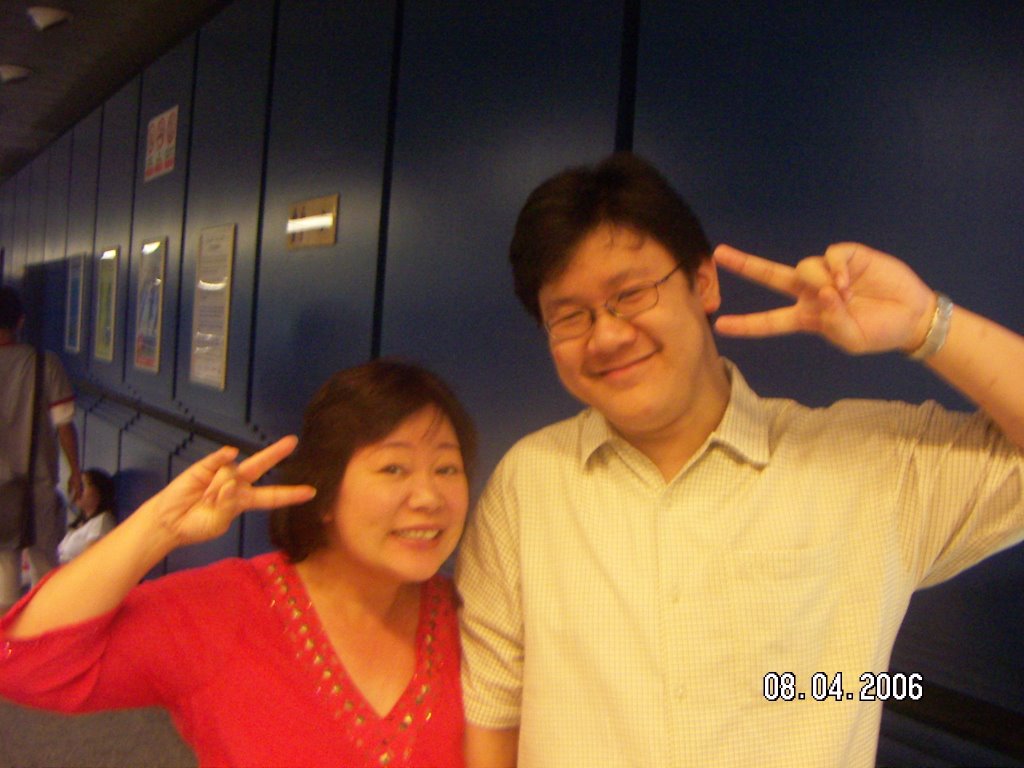
My name is Renhao. I find myself experiencing alot of unease and momentary unconfidence when I introduce myself with my Chinese name. It sucks big time to have someone give you a 0_0 face and bellow 'WHAT?' or 'AGAIN SORRY?' Sometimes people take the initiative to give me a nickname they can remember, like Rennie or Ren, but more often than not, bless them, they warp my name 180 degrees... I've had Ren-ho, Wren-ho, Renao... whatever. But hey, look at my Friendster URL below. One straightforward name to remember easily, instead of like weston638 or imcutebitemehahaz, you know what I mean. I don't blame the poor things for joining the ship later, I just feel blessed that the uniqueness of my name allows me to keep it undistorted in times like this.
I'm 18, having joined SIM/UB right after my 'O' levels. I have a Friendster account, and it is the reason why I didn't join Facebook sooner. I don't really want a ton of these things under my name. But well... just join lor. So here's my new Facebook account, if anyone else wishes to add me. My main blog... well, naming it mozartwannabe was quite a folly, but for the sake of my readers and for those who've kindly linked me I don't wish to put them through the trouble of changing their link. And I've no problem being a Mozart wannabe. :) But I might just move to Wordpress. Times be changing, I be lagging.
You might notice now that my writing style is highly informal and I love to digress into little lanes, and elaborate here and there. People say that's what they love in my writing, but it does get abit hard when I've to 'turn on' my Formal Write mode. Life's a game, they say, but we unfortunately can't yet do such things with a simple -fwmode.
Uh looks like I'm going on forever. I sometimes tell my readers not to bother reading till the end. People think 'Alright... finish this post and I'll go do XYZ.' The only problem is that I never seem to stop, and I really don't want my readers' loved ones to come back to find them unconscious from starvation or a burst bladder. So yes I'll say it now. I've only covered up to the URLs part from Kevin's rough guide on the Wordpress blog, so please if you have to go do whatever you need to do and come back later.
Alright. Special abilities... well I don't really think I have any to reeeaaally be proud of, so rather than special abilities I'll list my interests.
I love reading. I don't read as much fiction as I used to, but I still love reading things (except perhaps the papers, some textbooks, and the like). And from the love of reading I gained the love of writing. That's why I love blogging. I like telling people about my life, what I feel about certain things, the usual principles. I also do some of it, but Kevin's really kinda inspired me to make it a point to blog more about things that capture my attention or generates thoughts worthy (IMO) of sharing. Procrastination rears its ugly face in blogging, and when I don't complete the post the first time, or at least finish 3/4 of it, chances are you'll never see it. Procrastination tends to cut in when I write more serious posts, where I try to argue logically and soundly, especially in my Christian blog where my concern is that readers understand what and only what I'm trying to say, not gaining misconceptions from an ambiguous phrase. That is very hard for me, and when I hold off publishing to edit after I've had some time away from the post, it also sometimes never sees the light of day. I love blogging, but it highly depends on my mood. And blogging was the last thing on my mind during the holidays when I was wasting my life away. I love writing fiction as well, but that's taken a backseat (like... really really far back) with the million other things I have to do.
Music! Jazz, guitar, rock, metal, heavy metal, very heavy metal, death metal, black metal, classical, opera, oldies... I'm tempted to type you name it, I have it, but I've kinda grown to have a certain level of, shall we say integrity for myself, as a music aficionado/connoisseur, and the fact is that for every genre I know, there may well be 5 others that I'm not even aware of. Slowly, I'm discovering more genres. And, pardon for the seemingly arrogant phrasing, at this level of music appreciation, to me it's not about my taste anymore. Certainly my iTunes library contains music that I can click with. No sense to put stuff that I don't like in... as it is I have yet to hear every single MP3 in my library. Rather, I like to keep an open mind, where knowledge is the keyword. I explore music to know what a genre sounds like, it's characteristics, and proponents. And if I like it, I simply explore further. As for instruments, I can play the piano and the guitar (note: can play ≠ good)
I like anime. Don't ask me why. I just like it. Maybe it's the drawing, maybe the voices, maybe the special way they draw them when they're shocked/angry. Perhaps it's a way to escape from the drab depressing reality of the world we live in. It's nice to know that at least somewhere, you can be a Shinigami with insane spirit powers that run off the charts, or you actually can keep all sorts of animals from electric mice to psychic cats in palm-sized balls that interestingly shrink to pebble-size for storage on your belt. I don't really mind much, but to my knowledge I watch the most anime in my circle of friends. I'm following +-30 running series concurrently. Gasp.
On to IT skills. There isn't one I feel I'm particularly good at, but I find myself proficient in these areas...
I like to think, given that the information is there in the first place, that I can somehow get whatever I want out of the Net, without having to pay, and if possible, without having to register or signup. Through experience and some thinking I kinda sorted out the types of keywords one can use to get more accurate hits, without which you'd probably be digging aimlessly through 14, 534, 735 links. I taught myself HTML by playing around and editing my blog template, but that's fast going out of fashion. I edit audio files with Audacity, and recently tried my hand at video editing with (the desparingly sparse) Windows Movie Maker.
Photoshop. It was actually my brother who first picked it up to play with it. After seeing the wonders of the Healing Brush I picked the program up from... the uh appropriate sources and again taught myself how to use it, sometimes using my own photos to explore the vast capabilities of Photoshop. Gradually, that turned to me becoming the photo editor of the house, using the MS Office Picture Manager for minor adjustments, and Photoshop for adding stuff in, or really major editing, like Healing or removing subtitles from a snapshot of an anime episode... stuff like that. I'm proud of this particular piece, taken when my mother was enjoying the delicious green tea ice cream at Hilton's Japanese Buffet Dinner, where we celebrated my last birthday.

Whew. Ok. That's it. I'll be posting my thoughts on our dependence on the Internet next. Shalom till then.
My name is Renhao. I find myself experiencing alot of unease and momentary unconfidence when I introduce myself with my Chinese name. It sucks big time to have someone give you a 0_0 face and bellow 'WHAT?' or 'AGAIN SORRY?' Sometimes people take the initiative to give me a nickname they can remember, like Rennie or Ren, but more often than not, bless them, they warp my name 180 degrees... I've had Ren-ho, Wren-ho, Renao... whatever. But hey, look at my Friendster URL below. One straightforward name to remember easily, instead of like weston638 or imcutebitemehahaz, you know what I mean. I don't blame the poor things for joining the ship later, I just feel blessed that the uniqueness of my name allows me to keep it undistorted in times like this.
I'm 18, having joined SIM/UB right after my 'O' levels. I have a Friendster account, and it is the reason why I didn't join Facebook sooner. I don't really want a ton of these things under my name. But well... just join lor. So here's my new Facebook account, if anyone else wishes to add me. My main blog... well, naming it mozartwannabe was quite a folly, but for the sake of my readers and for those who've kindly linked me I don't wish to put them through the trouble of changing their link. And I've no problem being a Mozart wannabe. :) But I might just move to Wordpress. Times be changing, I be lagging.
You might notice now that my writing style is highly informal and I love to digress into little lanes, and elaborate here and there. People say that's what they love in my writing, but it does get abit hard when I've to 'turn on' my Formal Write mode. Life's a game, they say, but we unfortunately can't yet do such things with a simple -fwmode.
Uh looks like I'm going on forever. I sometimes tell my readers not to bother reading till the end. People think 'Alright... finish this post and I'll go do XYZ.' The only problem is that I never seem to stop, and I really don't want my readers' loved ones to come back to find them unconscious from starvation or a burst bladder. So yes I'll say it now. I've only covered up to the URLs part from Kevin's rough guide on the Wordpress blog, so please if you have to go do whatever you need to do and come back later.
Alright. Special abilities... well I don't really think I have any to reeeaaally be proud of, so rather than special abilities I'll list my interests.
I love reading. I don't read as much fiction as I used to, but I still love reading things (except perhaps the papers, some textbooks, and the like). And from the love of reading I gained the love of writing. That's why I love blogging. I like telling people about my life, what I feel about certain things, the usual principles. I also do some of it, but Kevin's really kinda inspired me to make it a point to blog more about things that capture my attention or generates thoughts worthy (IMO) of sharing. Procrastination rears its ugly face in blogging, and when I don't complete the post the first time, or at least finish 3/4 of it, chances are you'll never see it. Procrastination tends to cut in when I write more serious posts, where I try to argue logically and soundly, especially in my Christian blog where my concern is that readers understand what and only what I'm trying to say, not gaining misconceptions from an ambiguous phrase. That is very hard for me, and when I hold off publishing to edit after I've had some time away from the post, it also sometimes never sees the light of day. I love blogging, but it highly depends on my mood. And blogging was the last thing on my mind during the holidays when I was wasting my life away. I love writing fiction as well, but that's taken a backseat (like... really really far back) with the million other things I have to do.
Music! Jazz, guitar, rock, metal, heavy metal, very heavy metal, death metal, black metal, classical, opera, oldies... I'm tempted to type you name it, I have it, but I've kinda grown to have a certain level of, shall we say integrity for myself, as a music aficionado/connoisseur, and the fact is that for every genre I know, there may well be 5 others that I'm not even aware of. Slowly, I'm discovering more genres. And, pardon for the seemingly arrogant phrasing, at this level of music appreciation, to me it's not about my taste anymore. Certainly my iTunes library contains music that I can click with. No sense to put stuff that I don't like in... as it is I have yet to hear every single MP3 in my library. Rather, I like to keep an open mind, where knowledge is the keyword. I explore music to know what a genre sounds like, it's characteristics, and proponents. And if I like it, I simply explore further. As for instruments, I can play the piano and the guitar (note: can play ≠ good)
I like anime. Don't ask me why. I just like it. Maybe it's the drawing, maybe the voices, maybe the special way they draw them when they're shocked/angry. Perhaps it's a way to escape from the drab depressing reality of the world we live in. It's nice to know that at least somewhere, you can be a Shinigami with insane spirit powers that run off the charts, or you actually can keep all sorts of animals from electric mice to psychic cats in palm-sized balls that interestingly shrink to pebble-size for storage on your belt. I don't really mind much, but to my knowledge I watch the most anime in my circle of friends. I'm following +-30 running series concurrently. Gasp.
On to IT skills. There isn't one I feel I'm particularly good at, but I find myself proficient in these areas...
I like to think, given that the information is there in the first place, that I can somehow get whatever I want out of the Net, without having to pay, and if possible, without having to register or signup. Through experience and some thinking I kinda sorted out the types of keywords one can use to get more accurate hits, without which you'd probably be digging aimlessly through 14, 534, 735 links. I taught myself HTML by playing around and editing my blog template, but that's fast going out of fashion. I edit audio files with Audacity, and recently tried my hand at video editing with (the desparingly sparse) Windows Movie Maker.
Photoshop. It was actually my brother who first picked it up to play with it. After seeing the wonders of the Healing Brush I picked the program up from... the uh appropriate sources and again taught myself how to use it, sometimes using my own photos to explore the vast capabilities of Photoshop. Gradually, that turned to me becoming the photo editor of the house, using the MS Office Picture Manager for minor adjustments, and Photoshop for adding stuff in, or really major editing, like Healing or removing subtitles from a snapshot of an anime episode... stuff like that. I'm proud of this particular piece, taken when my mother was enjoying the delicious green tea ice cream at Hilton's Japanese Buffet Dinner, where we celebrated my last birthday.
Whew. Ok. That's it. I'll be posting my thoughts on our dependence on the Internet next. Shalom till then.
Subscribe to:
Posts (Atom)